


There's a nervous excitement. Visible is the cold breath exhaled by my competitors as they execute the "pre-race" shuffle on the starting line.
A swift movement of the hips.
I'm at my local Saturday morning race and I'm focused. Three, two, one...
Wait a second. I have to adjust my tracker. The same goes for the runner beside me.
The person waiting sighs. I'm not moving until… there! GPS ready, and I'm running.
In the mele, it's challenging to see a arm without a smartwatch on it. And this isn't only us athletes who use them.
This is a explosive, multi-billion dollar sector. Companies like Garmin lead the market, each with an extensive range of different versions to cater to a range of needs. According to how high tech the model you select, costs can range from a hundred pounds to thousands of pounds.
"It drives me insane, it's impossible to switch off."
"It comforts me… It acts as a companion encouraging me."
"Please don't notify me about a bad night's sleep."
A handful of the responses I've had from other smartwatch wearers when I ask what they their opinion is on theirs.
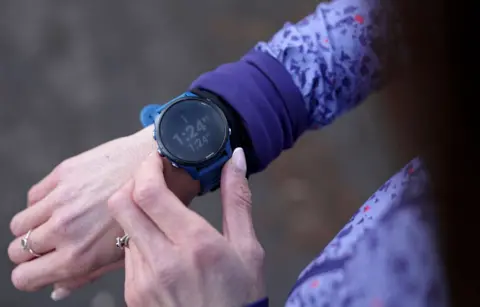
A Sea of Statistics
My feelings on my own device? Right now, irritating. It's reporting I'm off pace, making me wonder whether the overhead branches I'm passing under are disrupting my satellite signal.
A vast number of us strap these little monitors onto our arms and keep them on all day and night, ostensibly comfortable with the fact they're continuously tracking us.
A distant memory are the days when we used them solely to give us an estimation of our step count. Currently, they can analyse our nightly rest, stress levels, oxygen saturation, our VO2 max.
It's difficult to find a health indicator they fail to monitor.
But can they do what they claim to do? And are the data points we scrutinise a accurate representation of the truth? Do they improve our daily wellness, or do the avalanche of measurements and constant notifications just increase our daily stresses?

Addiction or Aid?
"I find myself getting a quite fixated with mine," one user admits.
While she loves how her device records her exercise, she finds some of its other capabilities "daunting" at times - a feeling initially realised during a major life event.
Before she realised she could put it into a specific mode, her smartwatch constantly alerted her she was not being energetic enough. Later on, the watch insists her she's had a restless night.
"I have a young baby, there's no point to be notified my sleep was poor," she says. "I know that only too well."
Is it not possible to just take it off?
"I suppose I could, perhaps, but I'm in this love-hate relationship with it," she continues. "I value it for its exercise data, I sometimes question whether the myriad other functions it can now do is perhaps overkill for me."
Inside the Device
Every device of smartwatch has its own unique way of monitoring your bodily functions and interpreting your data, but the vast bulk use sensors on the underside of the watch.
They usually emit minute LED lights onto your wrist which can observe pulsation, recording your BPM. Sophisticated devices analyse changes in the bioimpedance that runs through the skin to get an idea of your recovery state.
Expert Perspectives
A data scientist says that for most people for smartwatches, it's a "fine balance" - while the ever-evolving tech could realistically prevent illness, "detecting disease before we feel unwell", it could also turn us the tracked into the "worried well".
He points out that newer wearables can perform tests like medical-grade monitoring, which constantly monitor how stable the heart is. They can alert if someone is experiencing atrial fibrillation (AF), where there is abnormal impulses in the heart causing an irregular heartbeat.
This does not automatically signal someone is on the verge of a cardiac event, but it can give an advance notice they might be more at risk of a stroke in the years to come.
But how to understand these figures is complex. The expert fears that as further capabilities are incorporated, people may find it hard to fully contextualise their data.
"I have some doubts that the ability to monitor so much data is such a good idea," he says.
A health researcher studying patient behaviour echoes this sentiment. A study into the influence of wearable tech on a set of heart condition patients suggested a noticeable percentage of those who were given devices to monitor their heart health experienced greater stress and were "far more likely to use healthcare resources".
She identified a pattern with her patients - they spotted a worrying figure on their watch. They became worried. Their pulse increased. They got even more concerned. They looked a second time, and their heart rate increased again.
"When people are presented with stats about ourselves that we don't really understand then, of course, we are going to become concerned," the psychologist says. "We look, we obsess - it becomes a self-fulfilling prophecy."

